Tampilkan postingan dengan label sports. Tampilkan semua postingan

Selasa, 26 Juli 2011

Who was Chuck Taylor?


Search
: chuck taylor

Why: It kind of bugs me when people my age or older call Converse All Stars "Chucks." I had never heard the term "Chucks" before about 2005, but now, it seems like no one remembers the days of just plain ol' Converse. Erin, if you would:

Anyway, I am wearing navy ones today because I have a blister on the back of my heel.

Answer: He was a basketball player! He was born Charles Hollis Taylor in Brown County, IN, in 1901. He played his first professional game in March 1919 while still a high school student.

In the early-1920s, Taylor played for the Akron Firestone Non-Skids "industrial league" team. This team were charter members of the National Basketball League in 1937. They folded during WWII, but in 1949, the NBL merged with the Basketball Association of America to form the NBA.
Meanwhile, the Converse Rubber Shoe Company was founded by Marquis Mills Converse in 1908 to manufacture winterized rubber-soled footwear for men, women, and children. By 1910, Converse was producing 4,000 shoes daily, but it was not until 1915 that the company began making athletic shoes for tennis. The company's main turning point came in 1917 when the Converse All-Star basketball shoe was introduced. Then in 1921, Chuck Taylor walked into Converse complaining of sore feet. Converse gave him a job as a salesman and ambassador, promoting the shoes around the United States.

By the mid-20s, Taylor played and managed a group of cagers who played for the traveling Converse All-Stars barnstorming team. The team hosted basketball clinics in high school and college gyms across the country. Taylor "almost single-handedly taught Americans the fundamentals of basketball," making his name into a brand. In 1932, his signature was added to the Converse All-Star.
During WWII, he worked as a physical fitness instructor and coach for the Army and Navy. In 1944-45, he trained the Wright Field Air Tecs in a Navy pre-flight program at Marquette University.

He was also popular for his All-American picks. He only selected players he had personally seen play, many from small rural colleges where big-city sportswriters never went. His picks always were highlighted in the popular Converse Basketball Yearbook.
Source: Chuck Taylor Biography (by Abraham Aamidor), Wikipedia

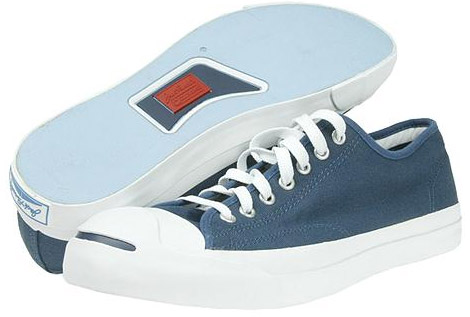
The More You Know: And who was Jack Purcell? Not the guy from "30 Rock" (that's Jack McBrayer / Kenneth Parcell). He was the 1933 world champion of badminton!
He designed a canvas and rubber badminton sneaker for B.F. Goodrich in 1935. In the 1970s, Converse purchased the trademark rights to Jack Purcell sneakers - which it still produces and sells today.

Kamis, 14 Juli 2011

What are Hunky Dorys?


Search
: hunky dorys

Why: On Reddit, "Storage Conditions":
"Treat Hunky Dorys like Gremlins. Keep them cool, dry & away from bright lights."

Answer: Thick crinkle-cut "crisps" from Ireland! Available in 6 strong flavours.
Hunky Dorys is known for its fun, extrovert and cheeky nature with strong flavours, including the infamous Buffalo flavour, inspired by the herd of Buffalo based near the factory in Co. Meath.
Infamous!

Source: Largo Foods

The More You Know: But look at this racy ad campaign:
Is that how female rugby players really dress? Do girls even play rugby? (No; yes.)

Rabu, 06 Juli 2011

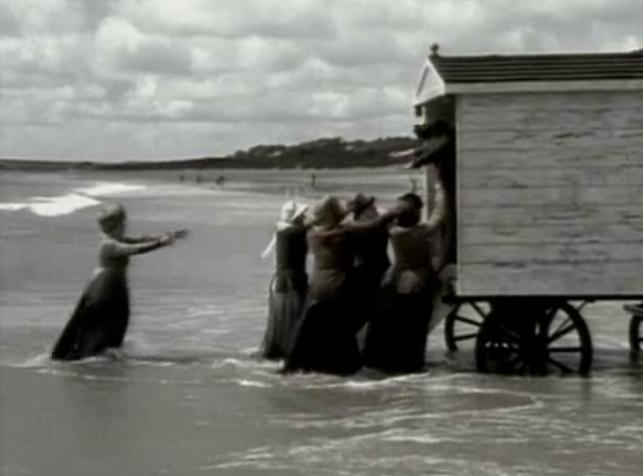
I want to see some old English bathing machines


Search
: bathing machine; dipper bather

Why: In Juliet, Naked by Nick Hornby:
Most museums in seaside towns had bathing machines, the peculiar Victorian beach huts on wheels that allowed ladies to go into the sea without exposing themselves to onlookers... Gooleness, typically, was the last town in the UK to employ dippers and bathers; dippers dunked ladies into the sea, and bathers immersed the gentlemen, and it was a calling that had mostly vanished by the 1850s.
Answer: Look at these hussies!
Well, that looks really fun.

Source: Google Images

The More You Know: Did you know these existed? I didn't. That will teach me to skim Jane Austen. Info:
The bathing machines in use at Margate, Kent, were described in 1805 as "four-wheeled carriages, covered with canvas, and having at one end of them an umbrella of the same materials which is let down to the surface of the water, so that the bather descending from the machine by a few steps is concealed from the public view, whereby the most refined female is enabled to enjoy the advantages of the sea with the strictest delicacy." People entered the small room of the machine while it was on the beach, wearing their street clothing. In the machine they changed into their bathing suit, although men were allowed to bathe nude until the 1860s, placing their street clothes into a raised compartment where they would remain dry.

Probably all bathing machines had small windows, but one writer in the Manchester Guardian of May 26, 1906 considered them "ill-lighted" and wondered why bathing machines were not improved with a skylight. The machine would then be wheeled or slid into the water. The most common machines had large wide wheels and were propelled in and out of the surf by a horse or a pair of horses with a driver. Less common were machines pushed in and out of the water by human power. Some resorts had wooden rails into the water for the wheels to roll on; a few had bathing machines pulled in and out by cables propelled by a steam engine. Once in the water, the occupants disembarked from the sea side down steps into the water. Many machines had doors front and back; those with only one door would be backed into the sea or need to be turned around. It was considered essential that the machine blocked any view of the bather from the shore. Some machines were equipped with a canvas tent lowered from the seaside door, sometimes capable of being lowered to the water, giving the bather greater privacy. Some resorts employed a "dipper," a strong person of the same sex who would assist the bather in and out of the sea. Some dippers were said to push bathers into the water, then yank them out, considered part of the experience.

Bathing machines would often be equipped with a small flag which could be raised by the bather as a signal to the driver that they were ready to return to shore.